


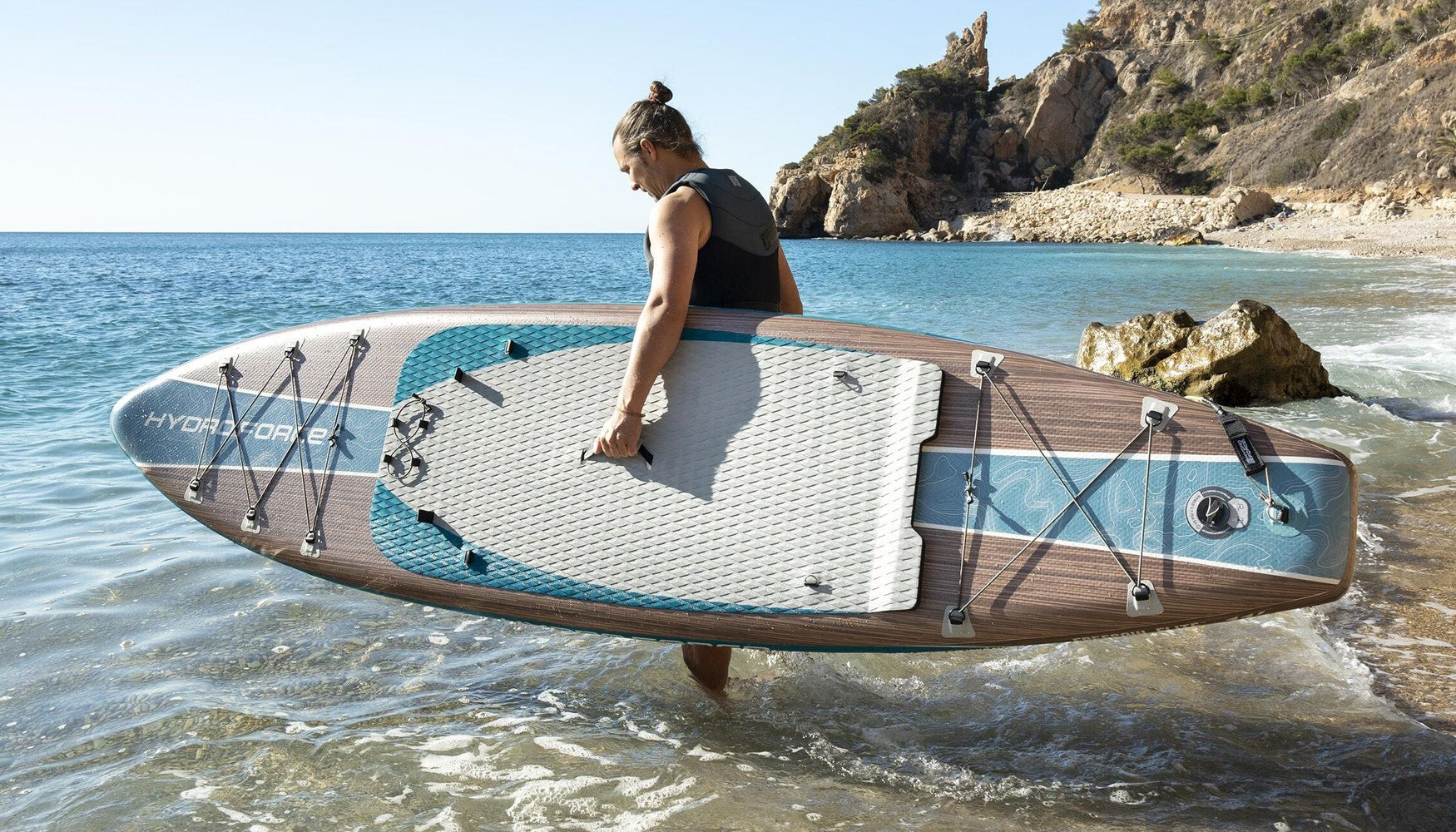
Today, there are many types of stand-up paddleboards (SUPs), just like there are many shades of white paint. For beginners and experienced users, inflatable SUPs are the best choice. They are easy to use and pack up to paddle wherever you find water.
Positioning: How to Maintain Your Balance on an Inflatable SUP
One of the most intimidating parts of learning to use a stand-up paddleboard (SUP) is getting on the board. It can be hard to keep your balance, especially if you are a new user.
First, there’s no shame in starting out balancing on your knees, and as you gain more confidence, you can work your way up to standing.
Next, remember that different bodies of water present their own unique challenges. Taking your SUP to the ocean? You'll encounter more surf and waves than calmer waters, such as a small lake. Choose a calm body of water to start when you practice standing up for the first time.
Remember, this is your own SUP journey, so take things at your own pace. If you fall into the water as you practice, just keep getting up again. You'll get it eventually!
That said, if you do decide to stand, here are a few tips for positioning and balance to keep in mind:
• Attach the safety leash to your non-dominant ankle or whatever is most comfortable
• Start in water deep enough to keep the fins off rocks or sand and swing one leg over the board so you are straddling it
• Position yourself on the center of your board (this is typically where your carry handle will be)
• Before you attempt standing, scoot or paddle out into deeper water (you can always sit cross-legged for easier paddling)
• Then set the paddle in front of you and grip the paddle as you move to all fours onto your knees and hands
• Try moving onto your knees first and paddling for a bit to get the rhythm down
• Once you’re feeling brave, move back to all fours and slowly move from crouching to standing with your feet parallel and hip width apart
• Make sure there’s a little bend in your knees and avoid locking them
• Practice moving from standing to sitting and vice versa in shallow water, making sure not to scrape or damage your fins in the process
• Focus on the horizon and not on your feet
• Push your hips forward, engage your abs and make sure your chest is upright, not leaning forward
• If you feel yourself starting to fall, lean towards the water and away from your board
BALANCING FAQs:
Why do I need to bend my knees while standing?
A little “give” in your knees lessens the pressure on your back and allows you to engage your core for better balance.
There is also an artery at the back of your legs. If your legs lock for too long, you might faint. So, it is important to keep a little bend in your knees.
Why should I fall away from my board and into the water?
If you fall into the water and not on your board, you’ll be less likely to injure yourself on the way down.
But if you’re feeling wobbly or unsteady, try moving back to your knees before you reach the point of falling to give your legs a break as you get more comfortable on the water.
Form: Putting the Paddle in Paddleboarding
Next up for SUP basics is paddling. Once you’ve assembled your paddle, you need to adjust it based on your height. The ideal paddle length is about 6-8 inches above your head so you don’t have to strain too much while paddling. If you’re having trouble making full strokes while standing, extend the paddle length a bit and see if that helps.
PRO PADDLE TIP: Hold the paddle upright with the blade on the ground; if you raise your arm the handle should align with your wrist.
Best Practices for Paddle Movement:
• Hold the paddle with one hand on the handle and your other hand mid-way down the shaft
• The hand on top should be the opposite of the side you’re paddling on (i.e. right hand on top for paddling on the left side of your board and vice versa)
• Make sure the blade is angled forward toward the board’s nose (so the curve should face up and forward)
• To paddle, bend your knees slightly, dip the oar end fully into the water and don’t move the paddle past your feet during each stroke
• To steer or “track” straight, switch sides every three strokes or so; if there’s wind, the number of strokes per side can vary depending on where the wind is coming from
• For turning, bend your knees even more than usual to get a solid base and use a swooping “C” stroke starting at the nose and arcing out away from the board; do this on the side of the board for the direction you want to go. Example - on the right if you want to turn right
• If you feel your arms getting tired, engage your core more to help propel you forward
Make sure you secure your paddle anytime it’s not in use by sliding it under the elastic cords on your board. Otherwise, you’re in store for a long doggy-paddle back to shore. Or a fun little game of “fishing for my paddle.”
During your first few journeys on the water, take as many breaks as you need, and experiment with standing, kneeling and sitting as well as your paddling movements.
Try to enjoy the scenery around you rather than putting too much pressure on mastering form. Stand-up paddleboarding is a wonderful opportunity to reconnect with nature and can be very meditative.
As you gain confidence on your board, your balance and paddling technique will improve. Before you know it, you’ll be making lists of “must-paddle” places for your next water-venture.


